

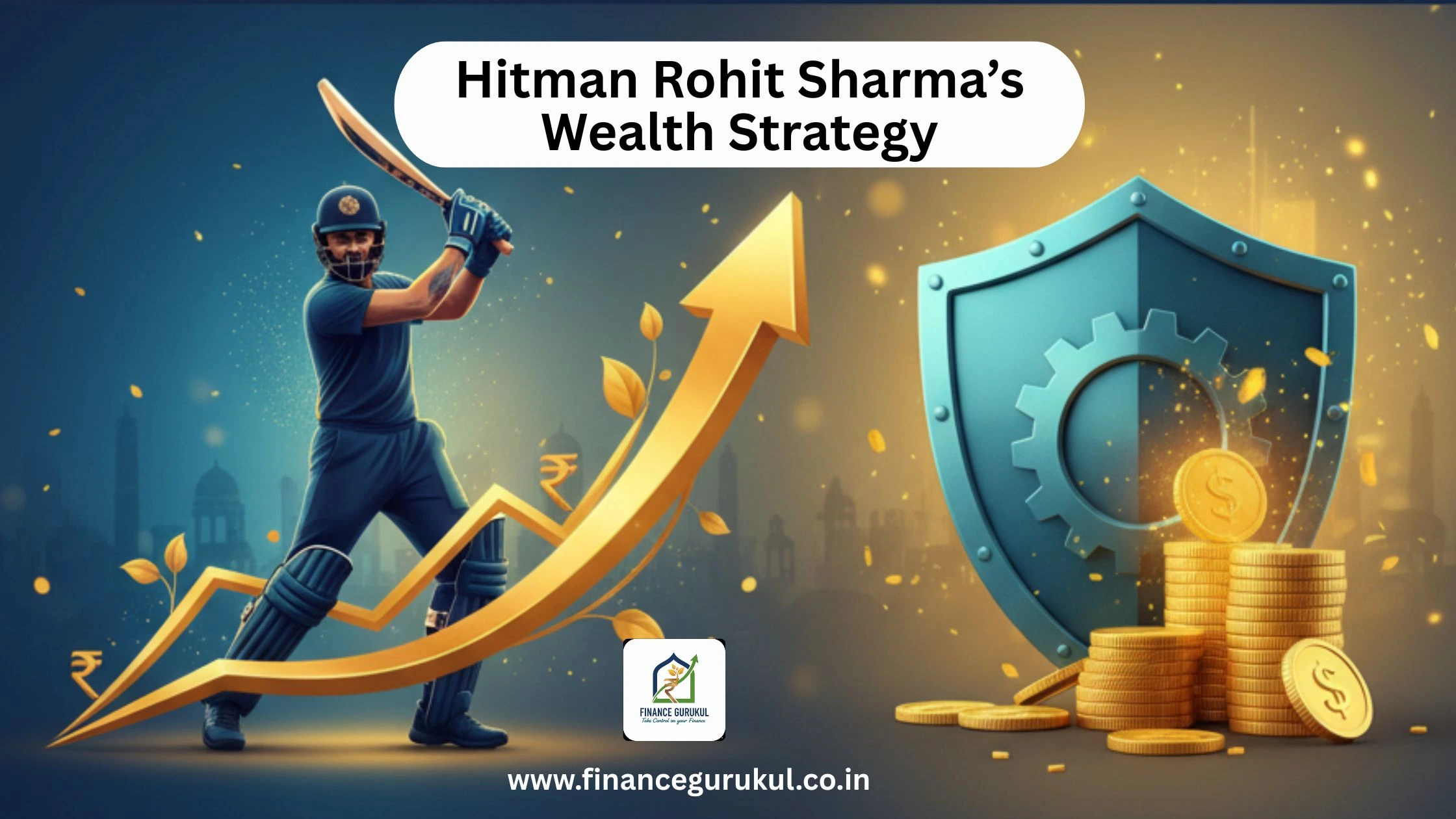
The ‘Hitman’s’ Test Match Strategy: How Rohit Sharma Builds Wealth for the Long Innings (A Long-Term Investing Guide)
Introduction: From T20 Sensation to Test Match Anchor
Rohit Sharma, often christened the ‘Hitman,’ is globally renowned for his effortless six-hitting ability, particularly in the limited-overs formats of cricket. Yet, his career narrative, especially the transition into an accomplished Test opener and subsequently a financially astute individual, holds some of the most profound lessons for a long-term investor.
The world of finance, much like the longest format of cricket, is not won by immediate, explosive gains, but by patience, discipline, and strategic risk-taking. The Test match, spanning five days, requires a batsman to survive treacherous spells, respect the good balls, and wait hours for the scoring opportunity—a metaphor that perfectly encapsulates the journey of building long-term, sustainable wealth.
This guide dives deep into Rohit Sharma‘s ‘Test Match Strategy’—a framework that saw him evolve from a volatile middle-order talent into an anchor for the Indian team, both on the field and in his personal finance. By applying the principles he perfected in the whites, you can build a robust, multi-generational financial empire that, much like a well-constructed Test innings, can withstand any market ‘bowling spell.’
1. Patience and Conviction: The Delayed Test Opening Analogy
One of the most defining phases of Rohit Sharma’s career was his protracted struggle to secure a permanent spot in the Indian Test side. Despite being a limited-overs star, his Test career was sporadic for nearly a decade. The turning point came late in his career when the team management showed unwavering conviction in his talent and moved him to the demanding opening slot. This move, post-2019, transformed his Test career.
The Investment Lesson: Staying Put Through Volatility
This journey teaches investors the critical role of patience and conviction in their long-term portfolio:
- Patience through the Middle-Order Struggle (Market Correction): Just as Rohit had to wait for the right role, investors must wait for their chosen assets—even the best-performing ones—to transition through periods of underperformance. A market correction is not the time to exit; it’s the time to hold firm, trusting the fundamental quality of the investment (the ‘talent’).
- Conviction in the New Role (Strategic Allocation): Rohit’s move to the opener’s slot was a high-risk, high-reward strategic allocation. Similarly, a long-term investor must occasionally make strategic, high-conviction calls—like shifting from debt to equity at a young age, or investing heavily in a high-growth sector—and stick to it despite initial doubt or market noise. The key is that the decision must be fundamentally sound.
- The Power of Time: Time in the market always beats timing the market. Rohit’s belated success shows that talent (quality asset) combined with time (long tenure) eventually yields massive returns. Do not churn your portfolio frequently; give your investments the time to settle and compound.
Key Takeaway: The biggest scores in investing, like in Test cricket, are often made in the late phase of the game, provided you have preserved your capital (wicket) during the difficult early spells.
Also Read: Unlocking Safe Investments with High Returns in India (2025 Guide)
2. Discipline and Automation: The Power of Consistent Scoring (SIP)
Rohit Sharma’s batting, particularly in his successful innings, is characterized by its disciplined, risk-averse start. He initially deals in singles and doubles, respecting the moving ball and the bowler’s line, before unleashing the ‘Hitman’ in the later stages. This phased approach is the perfect analogy for Systematic Investment Planning (SIP).
The Investment Lesson: SIP as the Default Defence
An SIP is the financial equivalent of Rohit’s disciplined start to an innings:
- Consistent Taps (Automatic Investment): SIP ensures you invest a fixed amount at regular intervals, regardless of market highs or lows. This automation removes emotional decision-making, forcing you to ‘score runs’ (invest) consistently. Rohit doesn’t try to hit a six on every ball; he takes ones and twos to keep the scoreboard ticking. The investor must do the same with small, consistent investments.
- Averaging the Pitch (Rupee Cost Averaging): By investing every month, you buy more units when the market (pitch) is bad (low) and fewer units when the market is good (high). This is called Rupee Cost Averaging, which smoothens out volatility and lowers your average cost per unit over the long run.
- The Compounding Effect (The Second Innings Score): Just as consistent singles eventually allow Rohit to settle and hit boundaries, SIP investments, even small ones, benefit immensely from compounding. Over 15-20 years, the return on the return becomes the largest component of your wealth. This is where the long-term compounding magic delivers the financial equivalent of a mammoth, match-winning second innings score.
3. Diversification and Risk Management: Playing the Ball on Merit
In Test cricket, Rohit doesn’t play the moving delivery (fast bowler) in the same way he plays a turning delivery (spinner) on the fifth-day pitch. He diversifies his technique and assesses the risk of each ball.
The Investment Lesson: Building a Multi-Asset Portfolio
Rohit Sharma’s personal financial portfolio mirrors this strategic diversification. His income and assets are not dependent on a single source, which is the cornerstone of risk management for high-net-worth individuals:
| Rohit Sharma’s Asset Class (The Pitch) | Financial Equivalent | Analogy to Risk Management |
| BCCI Central Contract/Match Fees | Fixed Income/Sovereign Bonds | The safest, most assured income stream. Your emergency fund, PPF, and high-quality debt funds. Zero risk. |
| IPL Salary | High-Yield Debt/Large-Cap Stocks | High, consistent income source. Stable, established equity funds (Large-Caps) that provide regular returns. Low-to-Moderate risk. |
| Brand Endorsements | Equity/Alternative Assets | High-revenue, but subject to performance and marketability. Corresponds to mid-cap or small-cap stocks; higher risk but with higher revenue potential. |
| Business Ventures (e.g., CricKingdom) | Direct Startup Investment | High-risk, high-return ventures. The financial equivalent of hitting a six—massive upside, but also high chance of failure. Very high risk. |
| Real Estate Holdings | Hard Assets/Inflation Hedge | Tangible assets that appreciate over time and protect against inflation. Provides stability and is less volatile than the equity market. |
- Never Go ‘All-Out’ in One Over: Rohit doesn’t attack all 6 balls in every over. Similarly, an investor must not put all their money into one asset class (like only Real Estate or only Crypto).
- The Tail-Ender (The Debt Shield): The debt portion (PPF, Fixed Deposits, RBI Bonds) in your portfolio acts like the team’s tail-enders—they may not score big, but they prevent the collapse of the entire innings and shield the portfolio during a bear market.
4. The Aggression vs. Defence Quotient (Rebalancing)
What distinguishes Rohit in Test cricket is his ability to shift gears decisively. After defending for 30-40 deliveries, he can suddenly hit two boundaries in an over to release pressure and change the momentum.
The Investment Lesson: Strategic Portfolio Rebalancing
This is the principle of portfolio rebalancing: adjusting your asset allocation back to its target mix when the market throws it out of balance.
- When to Get Aggressive (Sell Debt, Buy Equity): If the equity market has been crashing (a tough bowling spell), the equity part of your portfolio shrinks, and the debt part grows as a percentage of your total wealth. This is the time to get aggressive: Sell some debt and buy more equity to restore your original high-risk allocation. This is buying low.
- When to Defend (Sell Equity, Buy Debt): If the equity market has been booming (a scoring spree), your equity exposure might become too high, making your portfolio vulnerable. This is the time to defend: Sell some highly appreciated equity and book profits into safer debt to restore balance. This is selling high.
**Rohit Sharma’s Financial Mindset: ** The search results confirm Rohit’s successful financial trajectory, driven by his BCCI salary, massive IPL earnings (crossing ₹194 crores over his career), and endorsements (over 25 brands). This sheer volume of consistent, high-value income is the financial fuel that allows him to take strategic risks (like his angel investments in startups) with a small, manageable portion of his corpus, knowing his base is rock-solid.
5. Learning from the Ducks: Accepting Failure and the Long-Term View
Rohit Sharma, like every batsman, has had his share of low scores, ducks, and periods where the consistency evaporated. Yet, he never allowed a string of failures to fundamentally alter his technique or belief. He came back stronger, relying on his basics.
The Investment Lesson: The Emotional Discipline
- Don’t Panic on a ‘Duck’ (Market Crash): The biggest mistake investors make is selling an asset because its price is temporarily down (a ‘duck’ in the scorebook). Market crashes are inevitable. A disciplined investor sees a crash as a temporary setback in the long journey, not an end-of-game scenario.
- Separate Fundamentals from Fluctuations: If the reason you invested in a fund or stock (the ‘technique’ or ‘fundamentals’) is sound, a temporary drop (‘failure’) should not prompt a sale. Only change the investment if the fundamentals of the asset have permanently changed.
- The Final Score (Your Financial Goal) Matters: In a Test match, the only score that matters is the final total. Similarly, in investing, the only thing that matters is the value of your corpus when you need it (retirement, child’s education), not the volatile day-to-day fluctuations.
Also Read: Stocks vs. Mutual Funds: Which is Right for You?
Conclusion: Securing the Match for the Next Generation
Rohit Sharma’s career trajectory is a testament to the fact that success is a marathon, not a sprint. His Test match approach—a calculated blend of defence, patience, strategic aggression, and diversification—is the optimal blueprint for building a multi-crore wealth portfolio.
To achieve your financial independence, adopt the ‘Hitman’s’ Test Match Strategy:
- Start Solid (SIP): Automate your investments and ensure consistency is your default setting.
- Play on Merit (Diversification): Spread your capital across debt (for safety), equity (for growth), and hard assets (for inflation hedge).
- Respect the Good Balls (Patience): Ignore market volatility; stay invested for the long run (15+ years).
- Shift Gears Strategically (Rebalance): Use market corrections as opportunities to strategically invest more in growth assets.
By playing the long innings with this disciplined mindset, you don’t just secure your current match; you leave a massive, unassailable target for the next generation. That is the true measure of a financial champion.


